Call Us

Multi-brand solar, battery and water heating solutions for homes and businesses across Trivandrum and Kollam.
Call Us
Send Email
Location
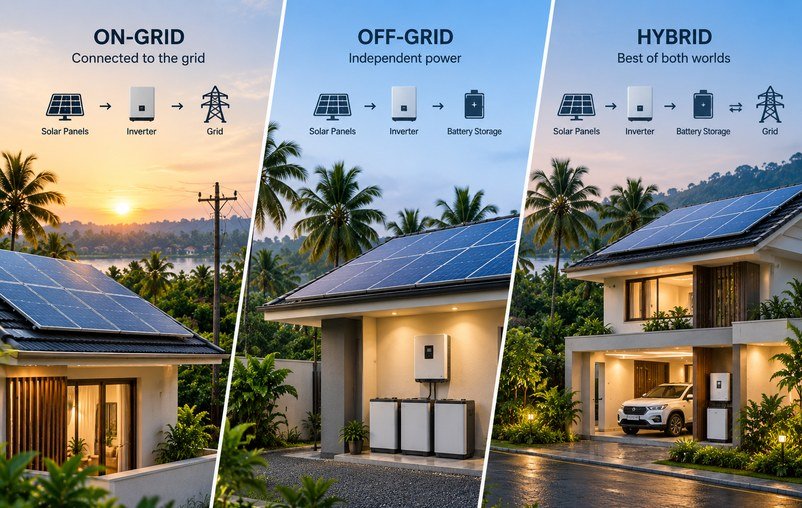
Three names, one roof, and a decision that changes what happens the next time the power goes out. The difference is simpler than the terminology suggests.
An on-grid system generates during the day, powers the house directly and exports the surplus for net metering credit. It has no batteries, which makes it the least expensive per kilowatt and the simplest to maintain. The trade-off is absolute: during a grid blackout it shuts down, for safety reasons. If your area has reliable supply and you mainly want the bill to fall, this is the right system.
An off-grid system relies entirely on batteries and cannot export to the grid, so it earns no net metering credit. It suits premises with no reliable utility connection at all. For most homes in Trivandrum and Kollam it is the wrong answer to the right question - people who want blackout cover usually want a hybrid.
A hybrid system does both jobs. It exports surplus for net metering credit and stores power in batteries so essential and heavy loads keep running through an outage. On a blackout it changes over within 10 to 20 milliseconds - fast enough that equipment does not notice. Priority settings let you run Solar–Battery–Grid for maximum autonomy, or Solar–Grid–Battery for maximum bill savings, so the same hardware can be tuned to what you actually care about.
 Bills are the problem, outages are rare - on-gridOutages are the problem and you want credit too - hybridThere is no usable grid connection at all - off-gridHeavy loads that must not drop - hybrid, sized to those loads
Sizing matters as much as the type. Luminous hybrid systems run from around 3kW for a home up to 10.5 kVA and beyond in three-phase for commercial premises - a survey establishes which band your loads actually fall into.
More on on-grid rooftop solar, hybrid solar systems, or book a free site survey.